Work Your Way, Search Wider: Skills and Web Search in Paxton
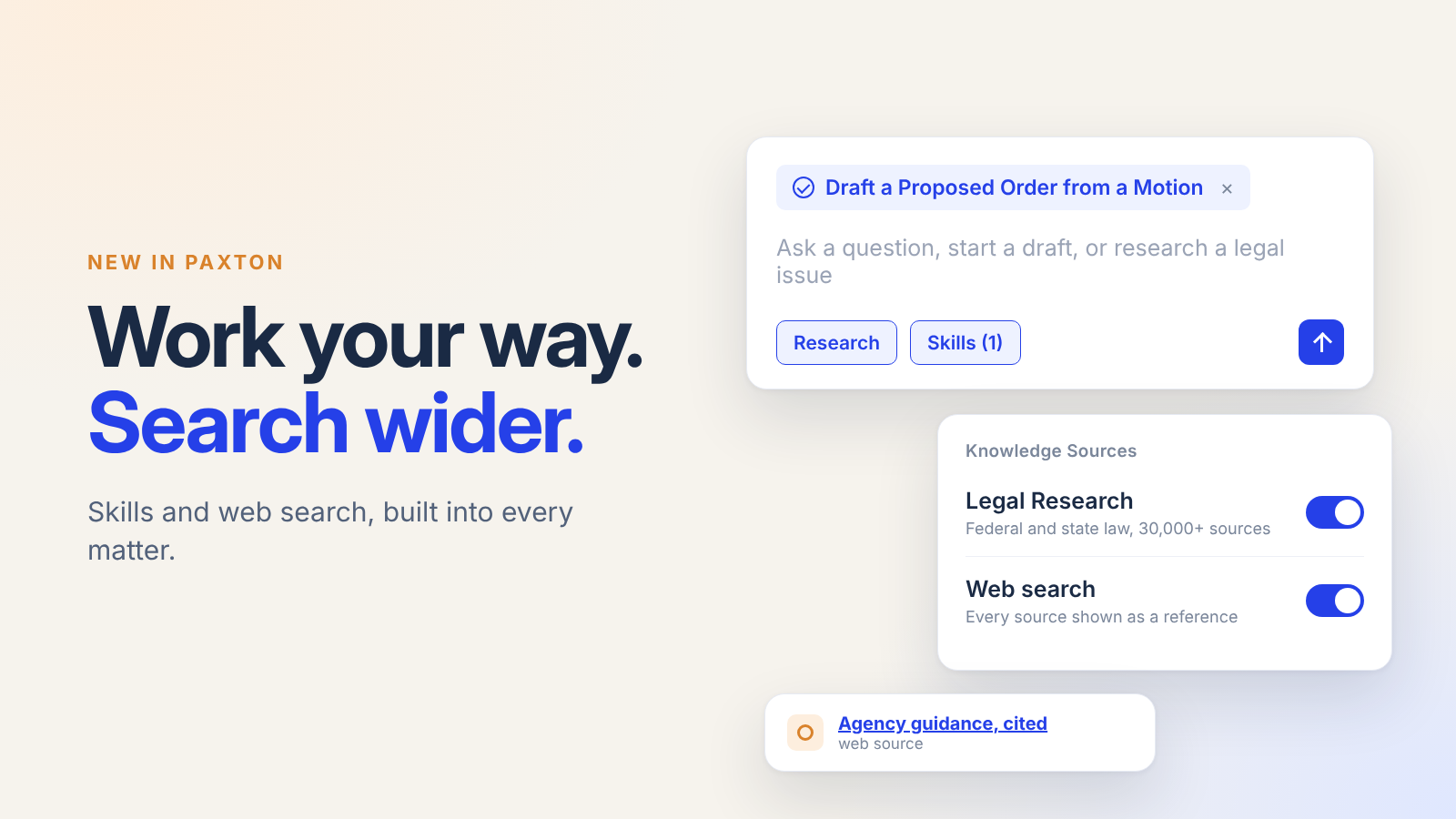
What do you need to get done today? Maybe it is the same review you run on every new matter, or a question about agency guidance that no research database covers.
Paxton can now help with both: Skills for the instructions your firm repeats, and web search for the questions that fall outside the law library.
Skills: your firm's way of working, built in
Every firm has its own way of doing things. How you summarize a deposition. Which phrasing a partner strikes on sight. Until now, getting Paxton to follow those rules meant explaining them again in every chat.
Skills live in one place in Paxton, whether Paxton built them or your firm did.
- Encode your house rules once. Turn your drafting style, review steps, and formatting standards into a skill, written in plain language.
- Start from skills built by litigators. Paxton's own skills cover common litigation tasks, like drafting a proposed order from a motion or drafting discovery from a complaint, and were built by our team of former litigators.
- See exactly what runs. Every skill is plain text you can read and edit. Nothing about how Paxton works on your behalf is hidden.

In our research, every attorney we spoke with said skills were most valuable for the people they delegate to. The attorney who knows how the work should be done writes the skill once, and a paralegal or junior associate runs it and gets work that meets that standard. You hand off the work without handing off the judgment.
Web search, with every source shown
Some of the answers litigators need are not in any research database. Agency guidance, recent filings, news coverage, secondary commentary. Before, those questions were dead ends.
Now Paxton can search the open web and bring those sources into the same answer as the law it already covers: federal and state primary law, plus more than 30,000 long-tail sources like agency decisions, local rules, and county codes.
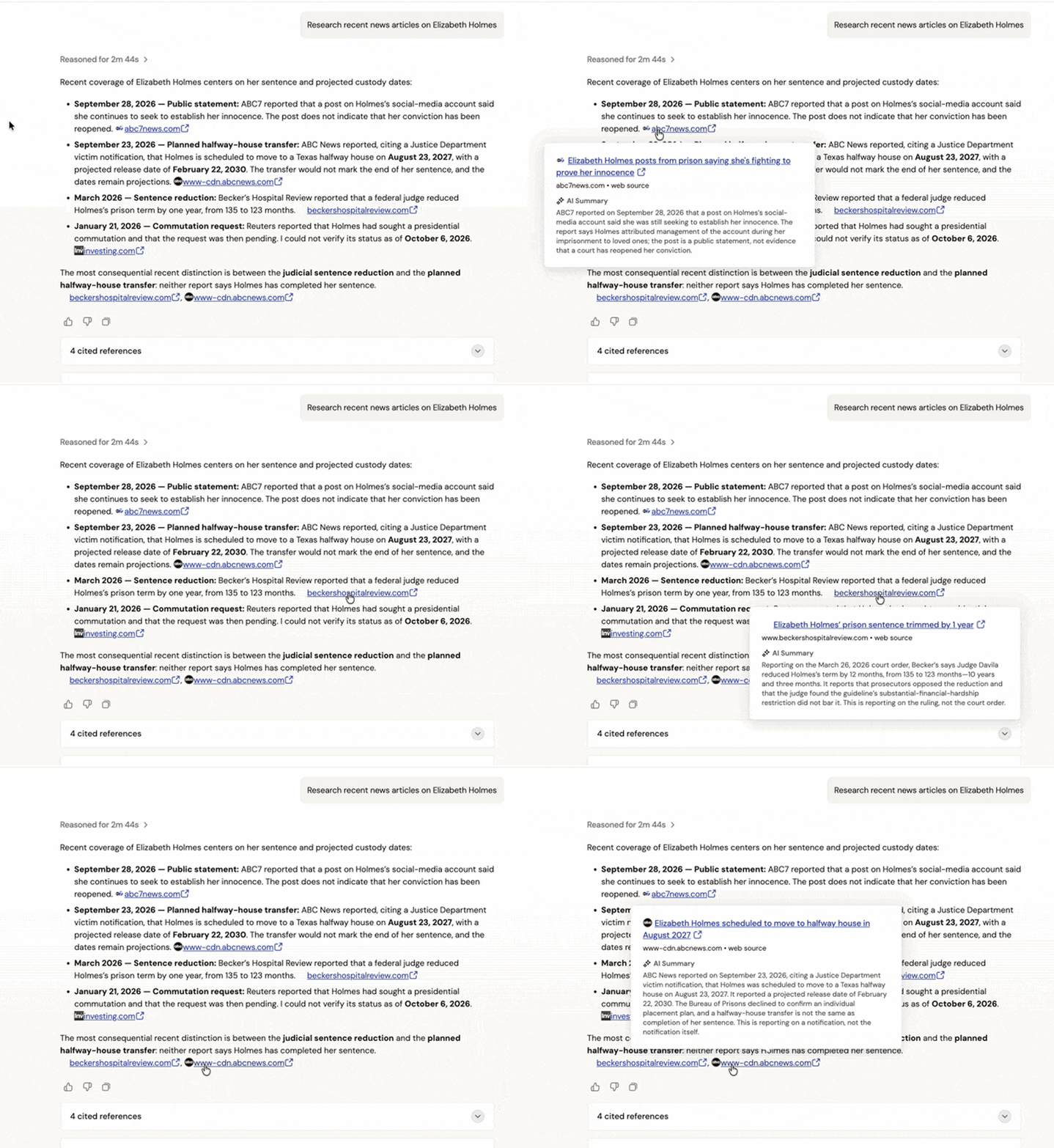
- Every web source is a clickable reference. You can see exactly where each outside fact came from and check it yourself.
- Web results sit alongside your authority, not in place of it. Primary law still runs through Paxton's citator, and outside sources are shown for what they are.
- You choose the sources. Web search is a toggle under Research, next to your legal research sources, so you decide when Paxton looks beyond the law library.
- One place to ask. No switching to a browser, copying results back, and losing the thread.
Built around the matter
Each of these features does something useful on its own. What makes them different in Paxton is where they live. Your skills and your web research sit inside the matter, next to your documents, the governing law, and your drafts. Nothing has to be copied from one tool to another.
Paxton is built by the team behind CoCounsel at Casetext and focused entirely on litigation. See it on one of your own matters. Start a 7-day free trial at paxton.ai, or book a demo.
.png)

.jpg)





.png)